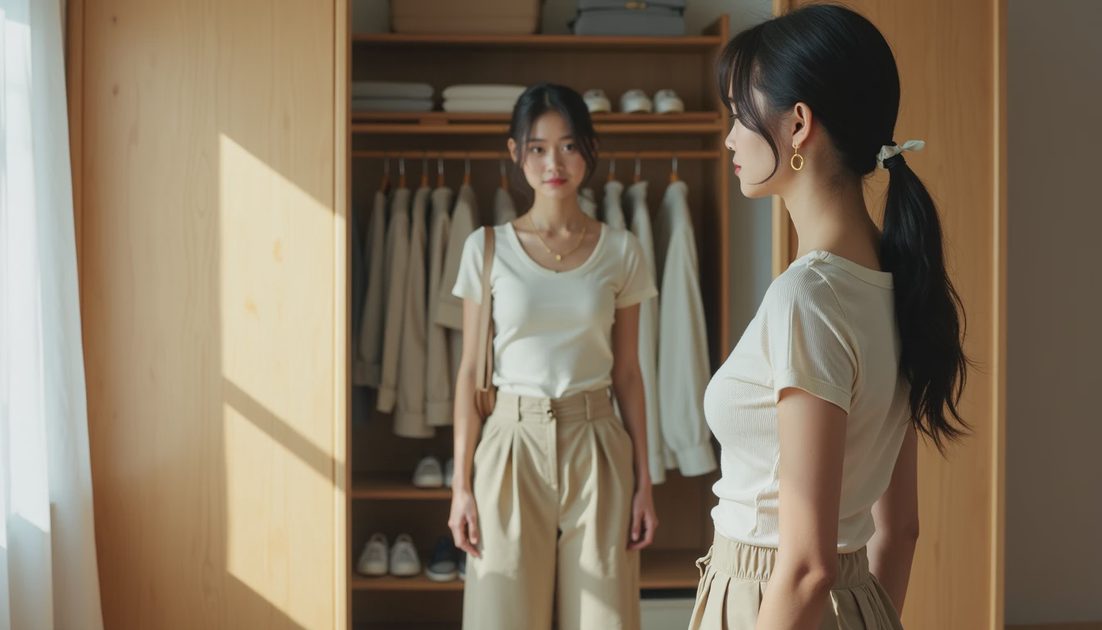
I've noticed something over the years of paying attention to outfits — both mine and other people's. Two people can wear what's essentially the same thing. A white tee and jeans. A sweater and trousers. A dress and sneakers. But one version looks polished and put-together, and the other looks just okay. Sometimes one even looks expensive, even when I know the pieces came from the same affordable places I shop.
The difference isn't the price tag. It's almost never the price tag. It's a handful of small, controllable things that anyone can pay attention to. Here's what I've learned about making simple outfits look more expensive than they are.
Fit and Shape
Fit is the single most important factor in whether an outfit looks expensive. A piece that fits well always, always looks more costly than an ill-fitting designer item. I've seen cheap thrift-store finds look incredible because they hung perfectly on the person wearing them. I've also seen expensive pieces look disappointing because the fit was off.
What good fit actually means: the shoulder seams sit where your shoulders actually end, not drooping down your arm. The waist of pants and skirts hits at your natural waist without gaping at the back. The length of pants doesn't pool on the floor or hit at an awkward spot on the ankle. The sleeves of tops and jackets end at a flattering point rather than covering your hands or cutting off at a strange place.
You don't need tailoring to get a decent fit — though it helps for special pieces. You mostly need patience while shopping. Try things on. Sit down in them. Move around. Check how they look from the side and the back. A piece that fits well in the dressing room might not fit well when you're walking across campus or sitting in a lecture hall. Be honest about what feels good on your actual body, not just what looks cute on the hanger.
Silhouette also matters. Simple outfits look more expensive when the proportions are balanced. A fitted top with wider bottoms. An oversized top with slimmer bottoms. Intentional volume in one area, restraint in another. When an outfit is all tight or all loose without intention, it can look less considered. The balance is what signals that you thought about the whole look.

Fabric and Texture
Fabric is the thing people notice without realizing they're noticing it. A fabric that drapes well, catches light softly, or has a subtle texture reads as higher quality than something flat, stiff, or overly shiny.
Natural fibers and blends that mimic them tend to look more expensive. Cotton, linen, wool, and rayon blends often drape better than stiff synthetics. Matte and semi-matte finishes usually look more sophisticated than high-shine fabrics, which can read as costume-y. Texture adds depth without adding visual noise — a ribbed knit, a brushed cotton, a subtle herringbone or tweed, a fine-gauge weave. These small surface details make a piece look more considered.
One fabric mistake I've learned to avoid: anything that wrinkles aggressively within ten minutes of sitting down. A beautiful blouse that looks like crumpled paper by the time you get to class doesn't look expensive, no matter what it cost. I do a quick scrunch test when I shop — I squeeze a handful of the fabric in my fist for a few seconds and see how it recovers. If it holds deep creases, I know it'll look messy by midday, and I put it back.
Color Consistency
The colors in an outfit don't need to match perfectly — matching too precisely can look dated — but they should feel like they belong in the same world. Outfits with clashing undertones or jarring color jumps tend to look less cohesive and, by extension, less polished.
Keeping your outfit in a consistent color family is the easiest way to create that expensive-looking harmony. Cream, beige, oatmeal, soft white. Blush pink, dusty rose, mauve. Light denim blue, soft navy. Sage green, muted olive. When all the pieces share a similar undertone — warm with warm, cool with cool — the outfit naturally looks more intentional.
Tone-on-tone dressing is a shortcut to looking polished. Different shades of the same color family worn together — cream top with beige pants, light pink tee with dusty rose cardigan — create a harmonious, thoughtful look that reads as more expensive than high-contrast color blocking. It's also incredibly easy to do if your wardrobe already leans into a cohesive palette.
That said, this isn't a rule against black or dark colors. It's about harmony. A soft black knit with cream trousers and beige accessories looks beautiful. It's the sudden, unintentional color clash — a warm beige with a cool, stark white, or a muted pastel next to a neon bright — that can make an outfit feel off without you knowing why.
Styling Balance
Simple outfits look expensive when every piece feels like it was chosen on purpose. The easiest way to achieve that is through balance — balancing fitted and loose, structured and soft, casual and polished.
If your outfit is entirely soft and relaxed — an oversized sweater, wide-leg lounge pants, puffy slides — it can tip into "I didn't try" territory. Adding one structured element brings it back. A structured bag with a soft outfit. Polished loafers with a casual sweater and jeans. A crisp button-down with relaxed wide-leg pants.
Similarly, if your outfit is entirely structured — tailored blazer, fitted trousers, stiff button-down — it can feel rigid and formal. Adding one soft element makes it feel more approachable. A soft knit draped over the shoulders. Hair down instead of tightly pulled back. Delicate jewelry instead of statement pieces.
The formula is simple: one structured piece keeps a soft outfit from looking sloppy. One soft piece keeps a structured outfit from looking stiff. That tension is what makes an outfit feel styled rather than just thrown on.
Shoes and Bag Effect
Shoes and bags have an outsized impact on how expensive an outfit looks. I've learned this the hard way — a cute outfit can be completely undermined by scuffed, dirty sneakers or a bag that's falling apart.
Clean shoes are non-negotiable. It doesn't matter if your sneakers cost fifteen dollars or a hundred. If they're clean and in good condition, they elevate the outfit. If they're scuffed, dirty, or worn down at the heel, they drag the whole look down. I keep a magic eraser near my door and do a quick wipe-down whenever my white sneakers start looking gray. It takes thirty seconds and makes a genuine difference.
Bag condition matters too. A simple canvas tote or an affordable crossbody looks great when it's clean, the straps are intact, and there's no visible wear and tear. The same bag looks sloppy when it's stained, fraying, or overstuffed to the point of losing its shape. I rotate between a couple of bags and try not to overload them beyond what they can hold comfortably.
The style of shoe also sets the tone. Sneakers read as casual. Loafers read as polished-casual. Ballet flats read as feminine and neat. The same outfit with different shoes communicates completely different levels of formality. For making a simple outfit look more expensive, loafers or clean, minimal sneakers are usually the sweet spot.
Common Mistakes That Bring an Outfit Down
I've made all of these mistakes, and I still catch myself making them sometimes. They're small things, but they reliably make a simple outfit look less polished.
Over-accessorizing or under-accessorizing. Too much jewelry — big earrings plus a statement necklace plus stacked bracelets — can make an outfit look busy and cheap. No jewelry at all can make an outfit look unfinished. The sweet spot is usually one to three small, delicate pieces that complement the outfit without competing.
Wrinkled clothes. This sounds obvious, but it's worth saying. A wrinkled shirt or crumpled pants will make even the nicest outfit look careless. I'm not someone who irons — I don't have time or patience for that — but I do hang things up promptly after laundry and smooth them out with my hands before wearing. A handheld steamer was one of the best small investments I've made for my wardrobe.
Visible wear and tear. Pilling on sweaters, fading in uneven patches, loose threads, missing buttons. These things accumulate slowly so you might not notice them, but they affect how your outfit reads. I keep a fabric shaver for removing pills from knits and do a quick scan of my clothes every few weeks to catch issues early.
Ignoring proportions. Tops that are too long and cut off at an unflattering point. Pants that bunch awkwardly at the ankle. Sleeves that are too long and cover half your hand. These proportion issues make clothes look like they don't belong to you. Pay attention to where things hit on your body and whether the lengths feel intentional.
Closing Thought
Simple outfits looking expensive has almost nothing to do with what you spent. It's about fit, fabric, color cohesion, balance, and taking care of what you own. The good news is that all of these things are within your control, and most of them don't cost a thing.
Pretty should still feel easy. And sometimes the most expensive-looking outfit is just a well-fitting tee, clean sneakers, and a little bit of attention to the details.
No notes yet — write the first one.